

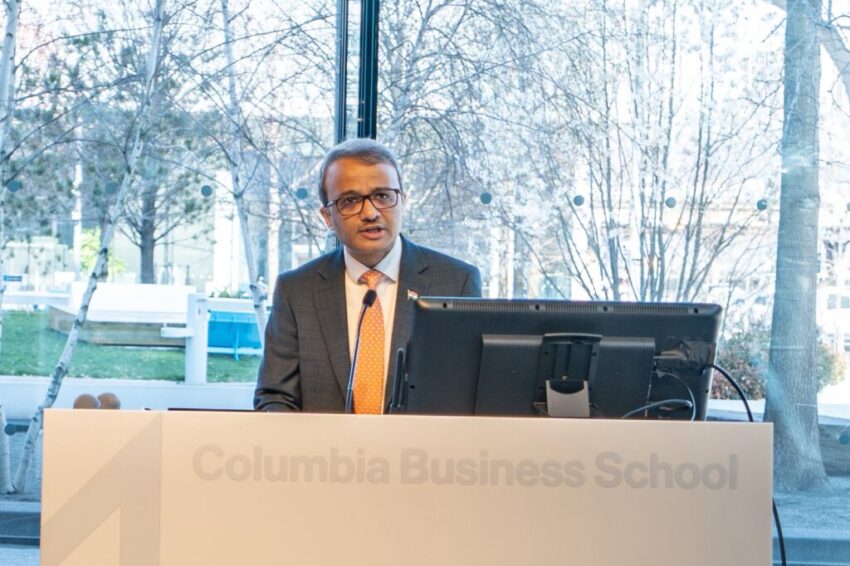
The 21st Annual India Business Conference was held at Columbia Business School in New York City on April 4, 2026. Hosted by the South Asia Business Association, a student run organization within Columbia Business School aimed at promoting cultural and economic interest in South Asian countries, this is considered a flagship event.
The conference was supported by State Bank of India New York as the Title Sponsor and TATA Group as the Gold Sponsor, according to information provided on Linkedin.

This year, the conference explored India’s growing influence in business, innovation, and sustainability. The theme was The New India Playbook: Capital, Creation & Culture.
At least two dozen heads of various companies addressed the conference, including Keynote Speaker Nikhil Kamath, co-founder of Zerodha, and billed by organizers on Instagramas a “Builder. Investor. Disruptor”, and K.T. Rama Rao, working President of Bharat Rashtra Samithi (BRS). Business leaders ranged from fashion design to investors and IT companies. Indian breakfast and lunch was provided, followed by an evening dinner reception.
ADVERTISEMENT


India’s Consul General in New York delivered the opening remarks in which he described the India-US corridor is one of the world’s most dynamic corridors. He highlighted how bilateral trade had surged from $19B in 2000 to $220B today, targeting $500B by 2030. Under the TRUST framework (Transforming Relationship Using Strategic Technologies), the two nations are now collaborating concretely across AI, semiconductors, defense, space, and other hi-tech areas, he noted. He singled out the 5.4 million Indian diaspora members who he said were key actors in the new playbook.

Speaking at a “Fireside Chat” during the Conference, BRS working president KT Rama Rao said, “Youth should not merely remain job seekers, but must aspire to become job creators,” the news outlet telenganatoday reported. He urged them to continuously upskill even as needed to be cautious about Artificial Intelligence. “This threat is real and imminent. Governments and societies are not fully prepared,” he said pointing to heavy job-losses at major multinational companies. He also noted that while India had adopted new technologies quickly, it could not longer “copy and paste” and need to create.
