

This year brings the 250th anniversary of the Declaration of Independence and the birth of the American experiment.
The peak of these revolutionary celebrations will come in the summer: The National Archives is planning a three-day Spirit of Independence Festival in June that will shut down Constitution Avenue, beginning a countdown to Independence Day. Tall ships will sail into Alexandria and Baltimore; the National Air and Space Museum will reopen major galleries on the Mall; and, of course, there will be fireworks across the region.
But you don’t have to wait: There’s much you can do, and see, right now.
Yes, you’ll hear a lot about George Washington and Thomas Jefferson and their fellow rebels, but this semiquincentennial is not just lectures about long-dead White men in powdered wigs. D.C. museums and cultural institutions are putting on concerts, theater, trivia nights, movie screenings, and exhibitions of early American and modern art. You can attend after-hours parties with DJs at galleries, and surround yourself with colorful flowers representing every state and territory.
ADVERTISEMENT
All of the following events take place between now and Memorial Day. We’ll spotlight even more anniversary happenings in the coming weeks and months.
D.A.R. Museum and Constitution Hall
Key dates: “Revolution in Their Words” from March 27 through March 27, 2027; “The D.A.R. Celebrates America 250” on April 18.
The Daughters of the American Revolution is celebrating revolutionary and modern America at its downtown headquarters this spring. A year-long exhibit called “Revolution in Their Words” uses the voices of those living in the colonies – soldiers, women, Native Americans, free and enslaved Black people – to tell what was happening during the Revolution through diaries, letters and official logbooks. It’s accompanied by “Preserving Patriotism,” a collection of autographs from all 56 signers of the Declaration of Independence on different media. Documents include a letter from Benjamin Franklin to his wife, beginning “My dear Child,” and a military commission issued by Samuel Adams when he was governor of Massachusetts. The museum is open Monday through Saturday and free to enter.
The busiest day is April 18: A concert at Constitution Hall honors female veterans with a performance by “Godmother of Soul” Patti LaBelle. (7 p.m., $115.10-$181.65). Earlier that day, families can explore DAR’s museum during America’s 250th Birthday Party, an open house with hands-on activities for all ages, plus cupcakes and refreshments. (10 a.m. to 12:30 p.m. Free.) 1776 D St. NW. dar.org.

Ford’s Theatre
Key dates: “1776” from March 13 through May 16; “Cabinet Conversations: Life, Liberty and the Pursuit of Happiness” on April 22.
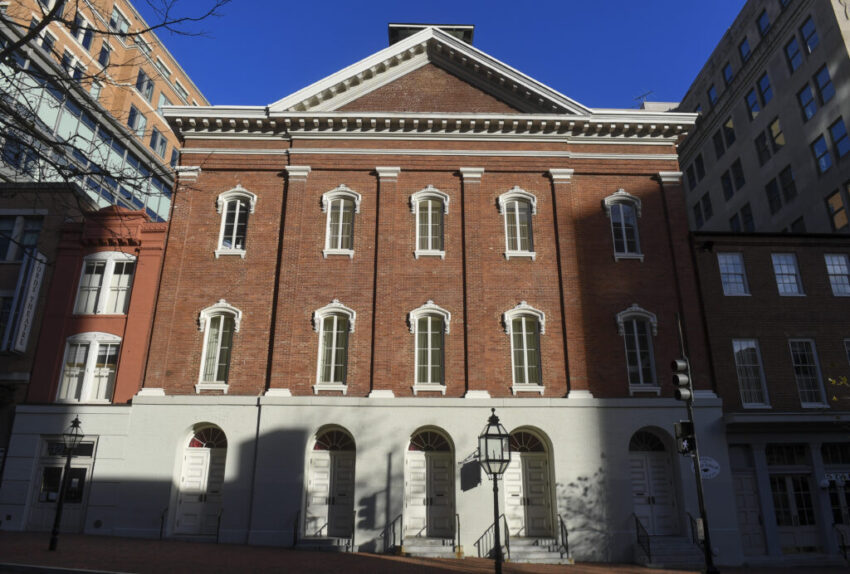
Decades before “Hamilton,” the story of American independence was told onstage in “1776,” which dramatizes the debates surrounding the creation of the Declaration of Independence, with humor and knowing winks. The winner of the 1969 Tony Award for best musical gets a revival at Ford’s Theatre this spring, with a cast including Jonathan Atkinson as John Adams, Jake Loewenthal as Thomas Jefferson and Derrick D. Truby Jr. as Benjamin Franklin. The theater hosts one of its “Cabinet Conversations” discussions on April 22, looking at the Declaration and the Constitution, and the “unfinished work” President Abraham Lincoln described in the Gettysburg Address. (5:30 p.m. Free.) 511 10th St. NW. fords.org. Tickets begin at $41.
Glenstone Museum
Key dates: “Ties of Our Common Kindred” on view now.
The largest private contemporary art museum in America is showing off works by American artists this year. The focal point is “Ties of Our Common Kindred,” an exhibition packed with heavy hitters – Andy Warhol, Jackson Pollock, Willem de Kooning, Ruth Asawa, Kerry James Marshall, Faith Ringgold, Alexander Calder, Cy Twombly and many more – reflecting the many branches and forms of modern American art. Separate ongoing exhibitions highlight works by Jasper Johns and Andrea Bowers. Open Thursday through Sunday. 12100 Glen Rd., Potomac. glenstone.org. Free; timed entry tickets required, except for visitors arriving by bus, or walk-in visitors on weekdays in March. Visitors must be at least 12 years old.
Library of Congress
Key dates: “The Two Georges” on view now through July 3; Family Day on March 14; Live! at the Library after-hours event series on Thursdays.
The Library of Congress has an ambitious year-long schedule for its America 250 events, including “The Declaration’s Promise,” an exhibit opening July 3, and a celebration of the American Folklife Center in September. Until Independence Day, you can see “The Two Georges,” an exhibition creating parallels between George Washington and King George III, who never met, by using their personal papers, scientific instruments, and maps and prints from the library’s collections. The library is also slotting 250-related events into its regular programming. Family Day, held on select Saturdays, is focused on maps from the colonial era and early America on March 14, with creative hands-on activities and talks from library staffers. (10:30 a.m. to 3:30 p.m. Free; timed entry tickets required.) Live! at the Library, a weekly after-hours event, will have multiple American-themed events in coming weeks, including a military trivia night on March 19 inspired by the library’s Veterans History Project. Check the library website for details and reservations. (Thursdays from 5 to 8 p.m. Free; timed entry tickets required.) 10 First St. SE. loc.gov. Free admission; timed entry tickets required.
Mount Vernon
Key dates: The Patriot’s Path reopens March 14; Revolutionary War Weekend takes place May 2-3.
As America prepares to celebrate the Declaration of Independence and the ultimate triumph of the American Revolution, few sites around D.C. are more intimately tied to the revolution than George Washington’s plantation, Mount Vernon. It’s been preparing for this moment: The first and second floors of the mansion reopened in December after an extended $40 million restoration project, and the education center, which features a 4D movie theater and exhibits about Washington, is reopening this month with new immersive elements. Its focus now is on the experience of the revolution: An army encampment called the Patriot’s Path, reopening March 14, allows visitors to go inside the tents of officers and enlisted men, talk to reenactors, learn more about daily needs like cooking and laundry, and maybe even try to “help” with tasks. It’s open daily and included with admission to Mount Vernon. A special Revolutionary War Weekend arrives May 2-3, with military drills featuring units portraying Continental soldiers and their Redcoat and Hessian enemies. Watch rifle and cannon fire, meet Gen. Washington, and go behind the scenes in his camp. 3200 Mount Vernon Memorial Hwy., Mount Vernon. mountvernon.org. $30-$35 ages 12 and older; $16-$22 ages 6 to 11; free for children younger than 5.
National Archives
Key dates: The Emancipation Proclamation and the 19th Amendment go on display in late March; “Free and Independent” opens late April.
The National Archives takes center stage in June and July, with a street party and public reading of the Declaration of Independence. But that doesn’t mean there’s nothing to see before then. In late March – the date has yet to be confirmed – the original Emancipation Proclamation and the ratified copy of the 19th Amendment are joining the Declaration of Independence, the Constitution and the Bill of Rights in the archives’ vaunted Rotunda, home of the nation’s most important documents. It’s the first time permanent document cases have been installed since 1952. That’s followed by “Free and Independent,” a temporary exhibition showcasing documents leading up to the Declaration and showing how Americans previously celebrated the 50th, 100th, 150th and 200th anniversaries of the founding document. 700 Pennsylvania Ave. NW. archivesfoundation.org. Free; timed-entry tickets are available for $1 but are not required.
National Gallery of Art
Key dates: “Celebrating American Art” on view now; “Dear America” from April 11 to Sept. 20; “National Gallery Nights: United We Create” on April 9; “Treasures of American Cinema” throughout 2026.
The National Gallery of Art is taking a multipronged approach to America 250. Its celebrated American galleries, home to treasures like John Singleton Copley’s “Watson and the Shark,” Frederic Edwin Church’s “Niagara” and Gilbert Stuart’s portrait of George Washington, have received a freshening up for the anniversary, with works including Bessie Potter Vonnoh’s sculpture “Day Dreams” and Thomas Wilmer Dewing’s “Lady With a Mask” going on display in the West Building. One of the “lobby” rooms off the East Garden Court now houses “Washington Before Yorktown,” a life-size painting of George Washington on horseback by Rembrandt Peale, along with a pair of busts of Washington. In April, the gallery opens “Dear America,” with more than 100 photographs, prints and drawings showing how artists have depicted “the country’s landscape, people, and concepts of freedom” over the past 250 years, with works by Dorothea Lange, Thomas Hart Benton, Carleton Watkins and Thomas Moran.
The gallery’s wildly popular National Gallery Nights series nods to America 250 in its final event of the spring season, with hands-on art activities, pop-up talks, music and cocktails during “United We Create.” While National Gallery Nights is usually held in the East Building, this one is expanding to the West Building’s galleries so participants can see “Celebrating American Art.” Admission is free, but tickets are required. A lottery is open on nga.gov between March 30 and April 2. Throughout 2026, the gallery is screening “Treasures of American Cinema.” The next series, on weekends in April, has the theme “Westerns as Reel Americana,” screening classics like “The Treasure of the Sierra Madre,” oddities like the Three Stooges musical “Rockin’ in the Rockies” and historical documents, including the 1903 silent film “The Great Train Robbery,” shown with live piano accompaniment. Sixth Street and Constitution Avenue NW. nga.gov. Free.

National Museum of American History
Key dates: “In Pursuit of Life, Liberty and Happiness” opens May 14.
When a museum has approximately 1.7 million objects in its collections, picking favorites can be hard. For the semiquincentennial, curators selected 250 items that they say celebrate the ideals of the Declaration of Independence. And rather than all 250 sitting in one exhibition space, they’re spread across the entire museum, encouraging exploration beyond the highlighted artifacts. Some, such as the Star-Spangled Banner and the 1776 Gunboat Philadelphia, will be familiar to visitors. Others, like Action Comics No. 1, the comic book containing the first appearance of Superman, which is going on display in the pop culture “Entertainment Nation” exhibit in April, are new to the museum’s collection. In all, 76 of the objects in “Pursuit” have never, or only rarely, been on display before, according to museum staff. Cases near the main entrances on the first and second levels juxtapose objects like a Coney Island hot dog cooker, a Nintendo game console and a microscope used by pioneering reproductive biologist Min Chueh Chang. Signs and a “thread” running through the museum will link all the featured items, and there will also be a printed booklet, with maps, a bingo card and other resources.
Curators are excited about more than just objects behind glass: Throughout the year, visitors can meet living-history actors portraying characters like Mary Pickersgill, the Baltimore flag maker who sewed the Star-Spangled Banner, and get an idea of how large Fort McHenry’s flag really was. They will be able to pick up a copy of the Declaration of Independence printed on a reproduction 18th-century printing press, or attend concerts ranging from popular colonial-era songs to modern jazz. Staff facilitators will help spark discussions over games or lead people to design their own memorial for George Washington. In short: This is an “exhibit” that will require – and reward – multiple visits. 1300 Constitution Ave. NW. americanhistory.si.edu. Free.
National Museum of Natural History
Key dates: Bison sculptures installed outside the museum on March 19; “Bison: Standing Strong” from May 7 until May 2029.
In 1886, Smithsonian taxidermist William Temple Hornaday ventured to Montana to collect samples of bison to create a display. He was so shocked by the disappearance of herds that he brought live bison back to Washington, where they were displayed behind the Smithsonian Castle. (Their popularity helped inspire the creation of the National Zoo, with Hornaday as its first director.) The Natural History Museum’s major exhibit this year is “Bison: Standing Strong,” which explores the cultural importance of the bison, America’s national mammal, and its journey to and from the edge of extinction, using a full-size bison, Native American artifacts and fossils of bison ancestors. Before that opens May 7, however, a trio of larger-than-life bronze bison will be installed outside the museum’s entrance on the National Mall. Sculptor Gary Staab and museum director Kirk Johnson discuss the importance of bison, and the statues, during a free evening event at the museum March 19. Arrive early to get a close look at the trio, which weigh approximately 2,500 pounds each. (6:30 to 8:15 p.m. Free; reservations suggested.) 10th Street and Constitution Avenue NW. naturalhistory.si.edu. Free.
National Museum of Women in the Arts
Key dates: “Historical Paintings by American Women Artists” from March 13 to Oct. 11.
The collection of the National Museum of Women in the Arts spans centuries and continents, but this special display in the museum’s Great Hall highlights portraits, landscapes and still-life works by 10 American artists, including Grandma Moses, Lilla Cabot Perry, Cecilia Beaux, and sisters Sarah Miriam Peale and Anna Claypoole Peale. The exhibit opens during Women’s History Month, when the museum has a full slate of events planned. 1250 New York Ave. NW. nmwa.org. Admission $13-$16; free for ages 21 and younger, and on the first Sunday and second Wednesday of the month.
Phillips Collection
Key dates: “Miró and the United States” from March 21 to July 5; “Phillips After 5: Miró by Night” on April 2; “Around and About Miró” film screening on April 16; “Miró and the United States” panel discussion on May 21.
Painter and sculptor Joan Miró is most closely associated with his home city, Barcelona, but Miró made multiple trips to the United States over more than 20 years, where he connected and collaborated with artists like Alexander Calder and Jackson Pollock. The Phillips Collection’s “Miró and the United States” exhibit, organized with the Fundació Joan Miró museum in Barcelona and part of the Phillips’s America 250 celebration, mixes Miró with works by more than 30 other artists, including Helen Frankenthaler, Mark Rothko and Louise Bourgeois, to show how artistic inspiration spread on both sides of the Atlantic. Programming surrounding the exhibition includes Phillips After 5, the monthly after-hours gathering, and a discussion with curators from the Phillips and the Fundació Joan Miró. 1600 21st St. NW. phillipscollection.org. Museum admission $10-$20, free for ages 18 and under. Admission free on the third Thursday of the month.

Smithsonian Castle
Key dates: Open from May 22 to Sept. 7; “American Aspirations” from June 2 to July 26.
The Smithsonian’s iconic Castle reopens for the first time in more than three years – albeit temporarily – for the 250th anniversary celebrations. It will serve as the Smithsonian’s visitors center, with a cafe and shop, as well as the home of “American Aspirations,” an exhibit examining how the founders’ ideals have been interpreted across succeeding generations. Featured artifacts are drawn from across Smithsonian museums, including the portable desk on which Thomas Jefferson wrote the Declaration of Independence, and Harriet Tubman’s book of hymns. 1000 Jefferson Dr. SW. si.edu. Free.
Tudor Place
Key dates: “Founding Fortunes: The Estate Sale of Martha Washington” through Dec. 31; monthly lectures and discussions, including “On National Commemorations: The Bicentennial, the Semiquincentennial and What We Can Learn About the Future of the Past” on May 12.
Tudor Place, a Federal-era mansion situated on more than five acres of grounds in Georgetown, is home to more objects related to George and Martha Washington than anywhere except Mount Vernon. Part of the reason is family ties – Martha Peter, who bought the land with her husband, Thomas, in 1805, was Martha Washington’s granddaughter – but most of the collection was purchased at the Washingtons’ 1802 estate sale, after Martha Washington’s death. “Founding Fortunes” is based around several rooms full of objects purchased at the sale. In 1776, Washington had a dozen camp seats made for his officers; the Peters bought a lot of six of them for $1.50 ($45.60 today), and only two remain. (The other is in the Smithsonian.) The exhibit includes a waxwork made by the owner of New York’s Fraunces Tavern, Chinese porcelain, and a locket containing George and Martha’s hair, which were clearly purchased as ways to memorialize America’s first couple. But the wall panels point out that there were enslavers and free Blacks at the auction, too, buying beds and lamps and tools not because they were sacred objects owned by the first president, but because they were practical and affordable used items. The exhibit uses the estate sale as an entry point to think about class and memory in the postrevolutionary period – and, yes, also as a chance to see Martha Washington’s bodice and other artifacts that are rarely on display. 1644 31st St. NW. tudorplace.org. Suggested donation $10 adults; $5 seniors, students and military; free for children age 5 and younger.
U.S. Botanic Garden
Key dates: “America’s State Flowers” from April 10 to Oct. 12
Surround yourself with the scents and colors of America throughout the U.S. Botanic Garden, as the official flowers of every state and territory are featured in “America’s State Flowers.” Rather than being grouped together in one exhibit space, the blooms will be displayed in their proper habitat, so you might see Minnesota’s showy lady’s slipper among the orchids, or find the saguaro cactus flower, representing Arizona, in the World Deserts section. The flowers are spread among the main conservatory, the outdoor gardens and the Bartholdi Fountain across the street, so seeing them all might take some time. (Don’t worry: A map will be available if you want to quickly locate your home state’s flower.) 100 Maryland Ave. SW. usbg.gov. Free.
Wolf Trap
Key dates: “The President’s Own” U.S. Marine Band on May 24
Wolf Trap hosts dozens of outdoor performances at the Filene Center between May and September, and has designated eight as part of its America250 series, “highlighting the sounds that have shaped America’s rich cultural tapestry.” They range from Broadway tunes to the Beach Boys to a new work called “American Mosaic” performed by the National Symphony Orchestra. The first arrives Memorial Day weekend, with the U.S. Marine Band performing a mix of songs from popular musicals and patriotic marches, followed by fireworks. The “Blast Off!” concert is free and requires registration. However, registration doesn’t guarantee admission, which is on a first-come, first-served basis, and the park will close when it reaches capacity. 1551 Trap Rd., Vienna. wolftrap.org. Gates at 6:30 p.m., concert begins at 8 p.m. Free.
Local passports
One goal of the 250th anniversary celebrations is to explore stories that are less familiar than Washington’s or Jefferson’s. Some jurisdictions have created history passports that reward going to visit historic sites. Prince George’s County’s Pastport to History highlights seven free, county-owned museums, including the College Park Aviation Museum and the Riversdale Historic Site. Get your “pastport” stamped at each location by the end of the year, and you could win a free trip, including airfare and hotel, to any of 27 National Trust for Historic Preservation sites in the U.S. (Find more details at pgparks.com/250.) The Virginia 250 Passport highlights 70 locations across the state, such as Thomas Jefferson’s Monticello in Charlottesville, Colonial Williamsburg, and the Virginia Museum of History and Culture in Richmond, with discounts for presenting a passport. Closer to home, Mount Vernon, the National Museum of the Marine Corps and Gadsby’s Tavern Museum are among the Northern Virginia landmarks. Visit five locations and enter a sweepstakes to win $2,500, memberships at museums and other prizes. (A list of locations and rules is available at virginiahistory.org.)