

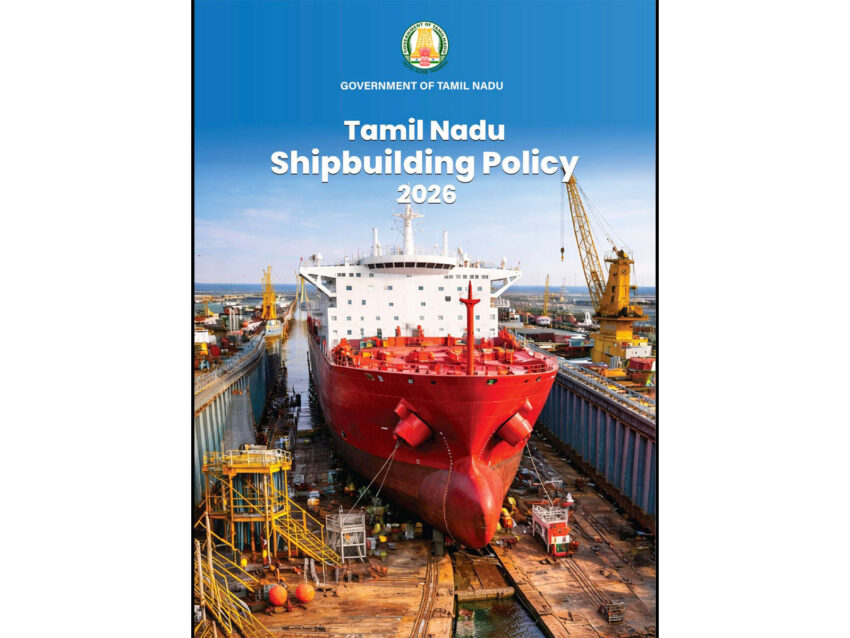

Chennai (Tamil Nadu) [India], March 4 (ANI): Tamil Nadu Government on Wednesday unveiled its Shipbuilding Policy 2026, aimed at establishing world-class shipbuilding clusters in the state and creating a robust maritime ecosystem covering other allied sectors such as ship repair and marine engineering, while positioning the state as a leading hub in the global blue economy.
The policy was unveiled by the Tamil Nadu Chief Minister, MK Stalin, during which other state projects and MoUs were also unveiled, including an agreement with MRF Tyres to establish a new tyre manufacturing facility at the State Industries Promotion Corporation of Tamil Nadu (SIPCOT), Iluppaikudi in Sivagangai district.
Following the announcement, Stalin, in a post on X, stated, “In a major boost to Tamil Nadu’s manufacturing strength, we signed an MoU with MRF Tyres to establish a new tyre manufacturing facility at SIPCOT Iluppaikudi in Sivagangai district with an investment of Rs. 5300 crore, creating around 1000 jobs and further strengthening our industrial ecosystem. We have also unveiled the ‘Tamil Nadu Shipbuilding Policy 2026’ to build a robust maritime ecosystem covering shipbuilding, ship repair, marine engineering and allied sectors, positioning Tamil Nadu as a leading hub in the global blue economy.”
Tamil Nadu Minister for Industries, TRB Rajaa, in a post on X, said the policy marks “a new chapter for Tamil Nadu’s maritime economy.”
He noted that the National Shipbuilding & Heavy Industries Park in Tamil Nadu (NSHIP, TN), India’s first SPV-led mega shipbuilding cluster, through the SIPCOT, the state will develop world-class shipbuilding clusters capable of supporting the construction of large commercial vessels, defence craft, submarines, green vessels, and offshore structures.
According to Rajaa, the policy introduces structured incentives to attract global shipyards and marine manufacturers and measures such as equity participation, asset leasing, capital support, and production-linked incentives are expected to encourage long-term investment in shipbuilding, marine engineering, and related manufacturing.
He stated that sustainability will be central to the initiative, with emphasis on green ship recycling, environmentally responsible shipbuilding practices, and Industry 4.0 skill development. Institutions will support workforce development for this emerging maritime ecosystem.
“The policy introduces structured incentives to attract global shipyards and marine manufacturers. Equity participation, asset leasing, capital support and production-linked incentives will encourage long term investment in shipbuilding, marine engineering and related manufacturing. Sustainability will be central to this effort. Green ship recycling, environmentally responsible shipbuilding practices and Industry 4.0 skill development will shape the sector’s growth. Institutions such as the Indian Maritime University and the State Shipbuilding Skill Council will support workforce development for this emerging ecosystem,” his post read.
The state Industries Minister higlighted Tamil Nadu’s natural advantages, including a 1,076 km coastline, deep-water access capable of handling vessels above 2,00,000 DWT, and a manufacturing base of over 40,000 factories, which will be leveraged to create a globally competitive maritime manufacturing industry.
“Tamil Nadu has always been a maritime state. From the Chola era to modern global trade, our coastline has connected us to the world. Now, under Honourable CM Thiru M K Stalin, we are building the industrial capability to lead the next phase of shipbuilding,” Rajaa added in his post.
The Shipbuilding Policy 2026 is expected to attract global investment, enhance India’s maritime capabilities, and strengthen Tamil Nadu’s position in the international shipbuilding and marine engineering sector. (ANI)