

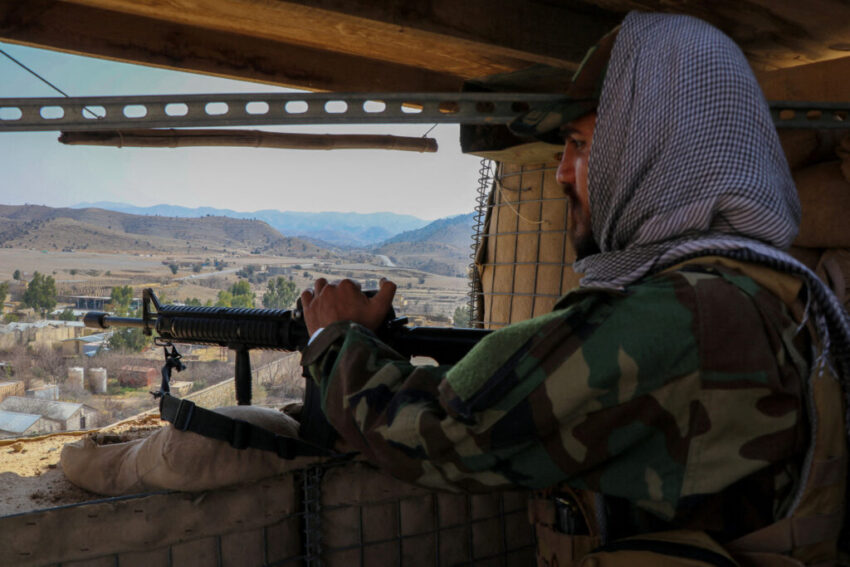

Pakistan declared “open war” with Afghanistan in a major escalation in fighting between the two countries, as both sides carried out cross-border strikes reaching as far as the Afghan capital and leaving at least dozens dead.
Pakistan’s military targeted “defense locations” in Kabul as well as in the border provinces of Kandahar and Paktia, killing more than 130 Afghan Taliban “operatives,” according to Information Minister Attaullah Tarar. Earlier, Afghan government spokesperson Zabihullah Mujahid said its forces killed 40 Pakistani soldiers during a border assault.
“Now it’s an open war between us,” Pakistan Defense Minister Khawaja Asif said in an X post. “Now there will be chaos and reckoning.”
Pakistan also shot down “small drones” launched by local militants north of the capital Islamabad, Tarar said in a post.
ADVERTISEMENT

The clash marks an escalation in fighting after months of cross-border strikes. Islamabad has targeted militants in Afghanistan, which it says is being supported by the Taliban government to plan attacks in Pakistan. The Taliban has denied the allegations.
Rajiv Dogra, an author and former Indian diplomat, said the Pakistan’s language declaring war “is only going to provoke the Afghanistan side even more” and signals an intention to inflict serious damage to the Taliban.
“Even if this subsides or goes down, it’s not going to be the end of the story,” he said. “The friction and the aims of the two sides are now far too apart to be bridged.”
The country’s dollar bonds fell Friday, with the notes maturing in 2031, 2051 and 2029 underperforming most peers in emerging markets.
Relations between Pakistan and Afghanistan have steadily broken down in the years since the return of the Afghan Taliban in 2021 following the withdrawal of US-led forces.
Pakistan had initially backed the Taliban takeover, betting that the new government would help rein in Islamist militants operating in Pakistan. Instead, those militants, known as the Pakistani Taliban, have stepped up their insurgency in tribal areas around the country. Islamist militants have also stepped up attacks in Islamabad, with a bomb blast at a mosque in the capital killing at least 31 people earlier this month.
“Pakistan has struggled to control the rising militancy on its own, as the porous border with Afghanistan provides the militants with a safe haven to retreat to in the face of military pressure,” said Pearl Pandya, senior analyst for South Asia at Armed Conflict Location & Event Data, a nonprofit that tracks political unrest globally.
Turkey and Qatar tried to broker talks between the two sides in late November, but the efforts failed. Tit-for-tat border clashes followed and continued through December.
Pakistan recorded its deadliest year of violence in a decade in 2025, as deaths from insurgent attacks climbed to 3,967. With borders between the two countries shut for months, supply disruptions have ensued, pushing up food prices in Pakistan.
The resurgent violence presents a new challenge for China, which has sought to act as a mediator between the two countries and protect its economic foothold in the region. China has deep ties and billions of dollars worth of investments in Pakistan via its China-Pakistan Economic Corridor, and has also been stepping up its engagement with the Afghan Taliban since its return to power.
A spokeswoman for China’s foreign ministry said Friday Beijing has been working on mediating the conflict via “its own channels” and urged both sides to exercise restraint. “China supports combating all forms of terrorism,” she said.
For India, the recent clashes have further deepened tensions with Islamabad, with relations already at a low point following last year’s cross-border clash. Islamabad has accused New Delhi of backing both the Pakistani and Afghan Taliban. Meanwhile, the Afghanistan and India have stepped up discussions of opening new trade routes bypassing Pakistan.
Iranian Foreign Minister Seyed Abbas Araghchi in a X post also called on the two sides to manage their differences “within the framework of good neighborliness and through dialogue.”