

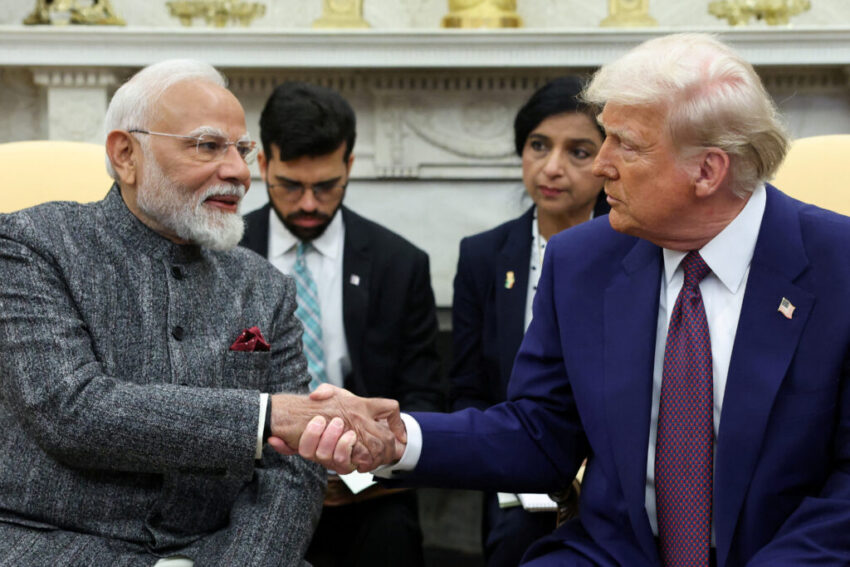

WASHINGTON/NEW DELHI (Reuters) -President Donald Trump said on Wednesday the United States is still negotiating with India on trade after announcing earlier in the day the U.S. would impose a 25% tariff on goods imported from the country starting on Friday.
The 25% tariff, as well as an unspecified penalty announced by Trump in a morning social media post, would strain relations with the world’s most populous democracy.
Later at the White House, the Republican president indicated there was wiggle room.
“They have one of the highest tariffs in the world now, they’re willing to cut it very substantially,” Trump told reporters. “We’re talking to India now – we’ll see what happens … You’ll know by the end of this week.”
ADVERTISEMENT
The 25% figure would single out India more severely than other major trading partners, and threaten to unravel months of talks between the two countries, undermining a strategic partner of Washington’s and a counterbalance to China.
What the penalty would be was not clear. Trump indicated initially, in a post on the Truth Social website, that the penalty was a response to India buying Russian arms and oil and its “obnoxious non-monetary Trade Barriers.”
When asked about the penalty later at the White House, he said it was partly due to trade issues and partly because of India’s involvement in the BRICS group of developing nations, which he described as hostile to the U.S.
In July, Trump said the U.S. will impose an additional 10% tariff on imports from any countries aligning themselves with the “Anti-American policies” of the BRICS.

The India announcement came as countries face a Friday deadline to reach deals on reciprocal tariffs or have a Trump-imposed tariff slapped on their exports. The White House launched a blizzard of other trade policy announcements on Wednesday.
EARLY WARNING
The White House had previously warned India about its high average applied tariffs – nearly 39% on agricultural products – with rates climbing to 45% on vegetable oils and around 50% on apples and corn.
“While India is our friend, we have, over the years, done relatively little business with them because their Tariffs are far too high,” Trump wrote in the Truth Social post.
“They have always bought a vast majority of their military equipment from Russia, and are Russia’s largest buyer of ENERGY, along with China, at a time when everyone wants Russia to STOP THE KILLING IN UKRAINE — ALL THINGS NOT GOOD!”
In response to his Truth Social post, the Indian government said it was studying the implications of Trump’s announcements and remained dedicated to securing a fair trade deal.
“India and the U.S. have been engaged in negotiations on concluding a fair, balanced and mutually beneficial bilateral trade agreement over the last few months. We remain committed to that objective,” it said.
Russia continued to be the top oil supplier to India during the first six months of 2025, making up 35% of overall supplies.
The United States, the world’s largest economy, currently has a $45.7 billion trade deficit with India, the fifth largest.
White House economic adviser Kevin Hassett said Trump has been frustrated with the progress of trade talks with India and believed the 25% tariff announcement would help the situation.
The new U.S. tax on imports from India would be higher than on many other countries that struck deals with the Trump administration recently. The tariff on Vietnamese exports is set at 20% and Indonesia’s at 19%, while the levy for Japanese and European Union exports is 15%.
“This is a major setback for Indian exporters, especially in sectors like textiles, footwear, and furniture, as the 25% tariff will render them uncompetitive against rivals from Vietnam and China,” said S.C. Ralhan, president of the Federation of Indian Export Organisations.
CONTENTIOUS ISSUES
U.S. and Indian negotiators have held multiple rounds of discussions to resolve contentious issues, particularly over market access into India for U.S. agricultural and dairy products.
In its latest statement, India said it attached the utmost importance to protecting and promoting the welfare of its farmers, entrepreneurs, and small businesses.
“The government will take all steps necessary to secure our national interest, as has been the case with other trade agreements,” it said.
The setback comes despite earlier commitments by Prime Minister Narendra Modi and Trump to conclude the first phase of a trade deal by autumn and expand bilateral trade to $500 billion by 2030, from $191 billion in 2024.
On Wednesday, Trump also said he had made a deal with India’s arch South Asian rival Pakistan to develop that country’s oil reserves. “Who knows, maybe they’ll be selling Oil to India some day,” Trump wrote on Truth Social.
Since India’s short but deadly conflict with Pakistan, New Delhi has been unhappy about Trump’s closeness with Islamabad and has protested, which has cast a shadow over trade talks.
“Politically, the relationship is in its toughest spot since the mid-1990s,” said Ashok Malik, partner at advisory firm The Asia Group. “Trust has diminished. President Trump’s messaging has damaged many years of careful, bipartisan nurturing of the U.S.-India partnership in both capitals.”
Besides farm products access, the U.S. had flagged concerns over India’s increasingly burdensome import-quality requirements, among its many non-tariff barriers to foreign trade, in a report released in March.
The new tariffs will impact Indian goods exports to the U.S., estimated at around $87 billion in 2024, including labor-intensive products, such as garments, pharmaceuticals, gems and jewelry, and petrochemicals.