


© Thomson Reuters
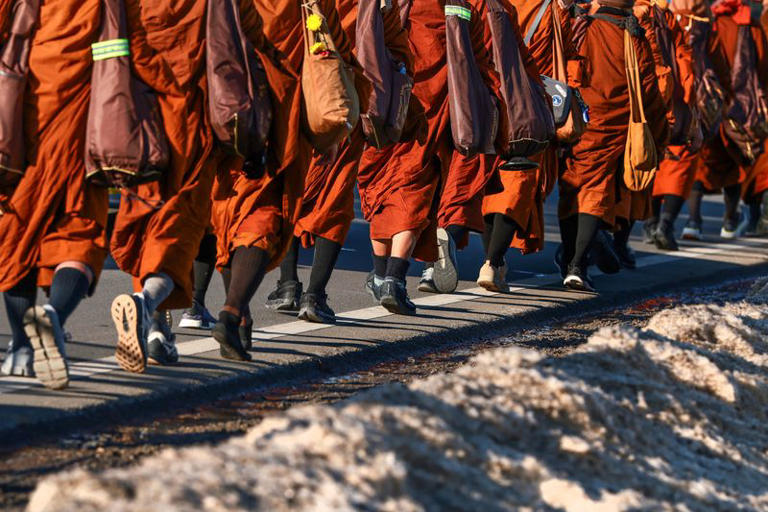
There was little pageantry in late October when 19 Buddhist monks began walking from Texas to Washington, D.C., to “raise awareness and mindfulness.”
America wasn’t really paying attention, and there wasn’t much interest at first. Even the monks weren’t sure what would happen. They didn’t have analytics or hard-spun data telling them that a long slog in wintertime was something that would command people’s attention. They went with their gut.
By the time the Walk for Peace arrived Tuesday in D.C., 108 days and 2,300 miles after leaving Fort Worth, it had become a social media phenomenon and an unexpected inspirational tether for millions who followed the trek online and the tens of thousands of people across eight states who greeted them along the way.
“This is a profound and sacred milestone on our journey for peace,” the group, led by Bhikkhu Pannakara, posted Tuesday on Facebook soon after crossing the Chain Bridge into D.C. “Our hearts are overflowing with gratitude for everyone who has walked with us – whether in person or in spirit – through every state, every mile, every single step.”
ADVERTISEMENT

The gratitude was reciprocal.
Many of those following the march, among them Americans who have felt unmoored, said it had provided them much-needed solace. Conflagrations over immigration, election security, the Epstein files, even the future of democracy filled them with dread, rage, fear. The simple but extraordinary act undertaken by the monks, they said, offered a bit of hope that a world turned upside down could be righted again.
Silver Spring resident Albee Shanefelter, 56, and his sister, Kris Llanes, 52, got up early Tuesday and headed down to the Chain Bridge so they could be among the first to greet the monks when they arrived in D.C. They brought a sign reading “Welcome to DC!! We LOVE you for doing this for All.”

“They’re an example of what the world needs more of right now,” Shanefelter said. “The overall message is that if they’re willing to walk from Texas to D.C., then maybe this is a very important thing and people really need to start taking peace seriously again.”
Shanefelter, who has Stage 4 prostate cancer, said watching the monks walk by in silence in their burnt orange and maroon robes was life-affirming.
“I feel if you can do things to serve other people and lift other people up it fuels your life force and then you can continue living,” he said. “Being part of something like this, it is just soul food.”
After arriving in D.C. a little after 8 a.m., the monks were met by a phalanx of more than 100 D.C. police officers on bicycles who accompanied them as they walked briskly through Northwest Washington to the American University campus. There, they spoke to a full house at the university’s Bender Arena.
Outside of the arena and elsewhere on campus, hundreds of people waited patiently hoping for even a brief glimpse of the monks.
“This is a beautiful thing to celebrate,” said River Thompson, an 18-year-old AU freshman from Illinois, as he stood in a long row of people holding signs and bouquets of flowers on a campus sidewalk. “This is such a great unity moment, especially when there’s definitely a lot of hate right now and oppression of people for their race, their gender.”
Danae Williams, 21, an AU junior from D.C., said she was happy to see so many people join her in the wait. “At a moment when everything is so volatile and so many are hurting, it’s a relief just to feel the connections and togetherness,” she said.
Maya Linson, who lives near the campus, walked over with her dog Max to see what had drawn so many people. “It’s inspiring people in a way that I find fascinating,” she said.
“Peace is something we don’t talk enough about,” said Linson, 42. “Peace has a lot to do with respect and the idea that differences make us stronger. I think we can all learn from each other.”
For Somman Siharath, 62, the trip to D.C. was a chance to reunite with the marchers. He first met them when they came through his home state of North Carolina a few weeks ago. There, he and others washed the feet of the worn-out walkers and helped bandage blisters and sores that had accumulated over the journey. Siharath, who is Buddhist, said the response the monks have received has been overwhelming.
“I’ve never seen anything like this for everybody to get together for peace,” he said. “It’s something that catches up with their hearts.”
The march’s organizers said they’ve been astounded by the reaction both online and in person.
“We never imagined this. We thought we’d just walk and … maybe encounter a few people here and there,” said Long Si Dong, a Fort Worth engineer serving as a spokesman for the walk. “But all of this – the love and compassion. People care so genuinely.”
Clark Strand, a contributing editor to the Buddhist publication Tricycle magazine and a former Zen monk, said that while the march is symbolic, it carries real weight and meaning.
“Those 19 monks might as well be 19 candles burning,” Strand said. “They are like beacons of hope for people. And I think you don’t have to be a Buddhist to feel that sense of hope from seeing somebody who’s willing to say, ‘This doesn’t work, there must be something better.’”
The hope for something better was evident at all of the stops the monks made Tuesday, including at an interfaith gathering at Washington National Cathedral where thousands of people turned out to see them.
Earlier in the day, a Montgomery County social worker who asked to be identified by only her first name, Valeria, because she works with immigrant families, said she came to see the monks to be there for people who are afraid to leave their homes or afraid to say anything at all.
Holding a newly purchased “Walk for Peace” T-shirt she waited for the monks on Nebraska Avenue NW across from the church by American University where the marchers had stopped for lunch.
“I hope for unity. I hope for kindness, I hope for forgiveness,” the 36-year-old said. She stopped to wipe away tears. “I hope for a chance to live peacefully.”
At that moment several of the monks began to exit the church.
“Oh my goodness, oh my goodness,” she exclaimed, and began to cry again.
Wiping away more tears and smiling, she said she will continue to advocate for people who are afraid to speak. And, she added, “I’ll take every step with kindness.”
The March for Peace culminates Wednesday (Feb.11) in Washington as the monks will travel in the morning to the Peace Monument at the U.S. Capitol and then walk to the Lincoln Memorial for a concluding ceremony that begins at 2:30. On Thursday morning, the monks will walk from Navy-Marine Corps Memorial Stadium to the steps of the Maryland State House in Annapolis for a final public event.