

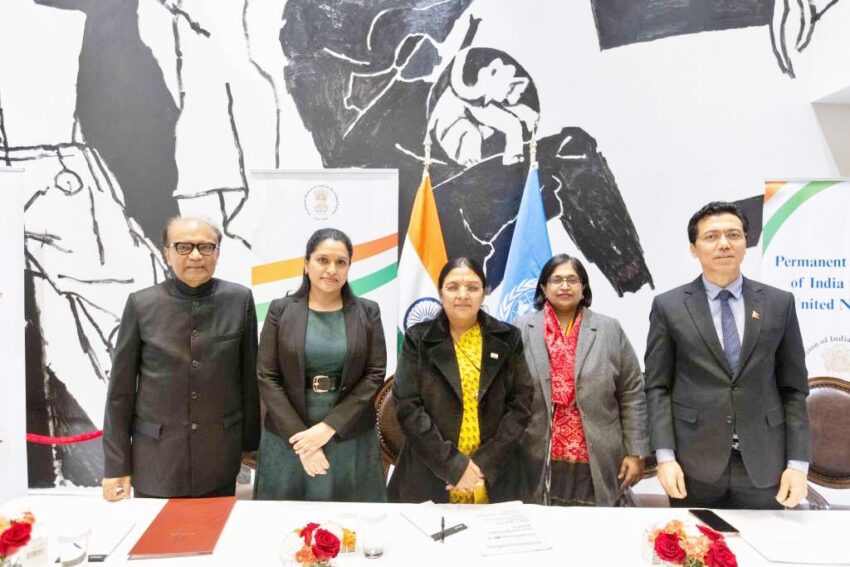

United Nations – There is a need to integrate new technologies in the education of Hindi language to make it easy for the Indian Diaspora to learn it, although the government of India is making major efforts to popularize Hindi globally, said Chief Guest, India’s Minister of State for Women and Child Development, Savitri Thakur.
Thakur was speaking at the World Hindi Diwas commemoration held February 2, 2026, organized by the Permanent Mission of India, attended by government of India officials and diplomats, the UN officials, other diplomatic corps, Hindi scholars and members of the Indian Diaspora.
Important attendees included India’s Deputy Permanent Representative to the UN Yojna Patel, Permanent Representative of Nepal Lok Bahadur Thapa, Permanent Representative of Mauritius Milan Jaya Meetarbhan, and Deputy Permanent Representative of Guyana Trishala Simantini Persaud.
This was the third annual celebration of the World Hindi Diwas at the UN organized by the Permanent Mission of India to the UN. The first Hindi Diwas was commemorated in November 2024, with the second commemorated in October 2025.
ADVERTISEMENT


The UN has designated January 10 as the World Hindi Day or Vishwa Hindi Diwas. Initiated by the Government of India, this day was first established in 2006 to promote Hindi as a global language and commemorates the day Hindi was first spoken in the United Nations General Assembly in 1949. India celebrates its own national Hindi Diwas on a separate day.
Speaking on the occasion, Deputy Permanent Representative of India, Yojna Patel, outlined the successful efforts by the Permanent Mission of India to include Hindi in the list of non-official languages at the UN. She elaborated on India’s partnership with the UN Department of Global Communication on the webcast of UN News in Hindi, and India’s contribution of $8 million to popularize Hindi at the UN.
Speakers from the Caribbean countries and Nepal gave credit to Hindi language in preserving and promoting culture in their countries.
The Hindi at UN Project which was renewed earlier this year for five more years, uses Hindi for public outreach through social media, newsletters and a UN News website to connect with millions of Hindi-speaking people worldwide. The Hindi social media network boasts around 137,000 total followers, while accumulating over 3.7 million views across all channels.

Under this project, the UN Hindi news website has attracted approximately 346,000 views from 193,000 active followers, with a large portion of the audience between the ages of 18 and 34. The UN has also launched a Hindi WhatsApp channel.
Last year, at the commemoration in October 2025, representatives from member states had acknowledged the contribution of Bollywood Films in giving exposure to Hindi language and Indian culture, thus popularizing Hindi in countries including Russia, Egypt, Africa and Latin America.
Hindi is also popularized through educational institutes including Harvard, Columbia, Cornell, Chicago, Texas, Oxford and Cambridge, and in Stockholm which offer degrees and courses in Hindi. Hindi has been integrated into education in Mauritius since 1954 with various institutions including the Ramayan Center, the Hindi Prachar Sabha and The World Hindi Secretariat continuing to promote the language.
Other countries including Guyana, Suriname, Trinidad and Tobago and Nepal also have local educational institutes offering education in Hindi at primary and secondary levels in schools, along with special courses in Hindi. Students from these countries also go to study Hindi in India. In Nepal, Hindi is the mother tongue of nearly 100,000 people and at least 25,000 use Hindi as a secondary language in his multilingual and multicultural country.