

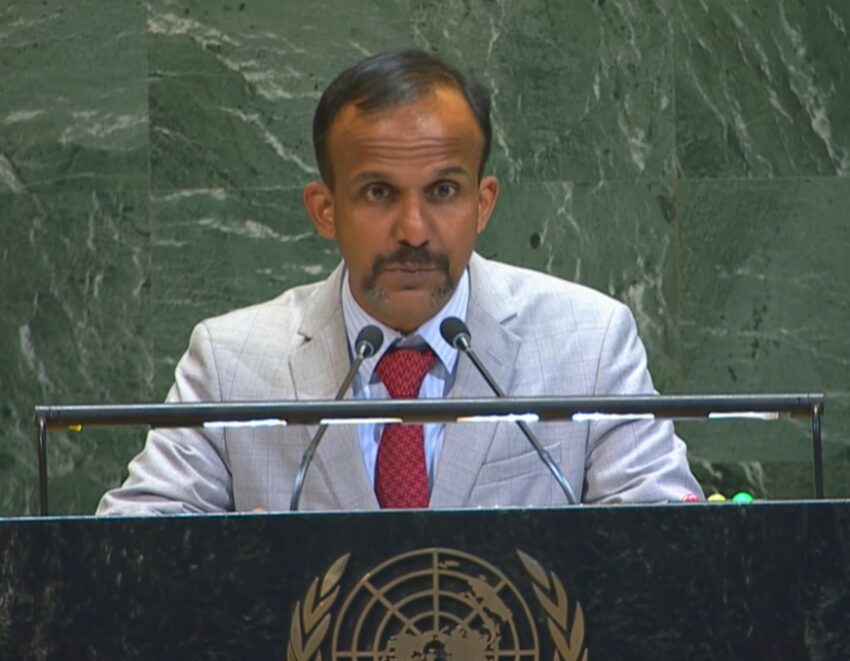
United Nations – India accused Pakistan of having a divisive strategy disrupting the hitherto work and future goals of the United Nations. India’s Diplomat Eldos Punnoose said Pakistan follows a divisive agenda at a time when the United Nation’s call of the moment is for member states to be united.

“At a time when member states have to rise beyond their narrow considerations, Pakistan continues to misuse all platforms and processes in the UN to drive their divisive agenda,” Punnoose said.
Punnoose was speaking to the UN General Assembly January 15, 2026 which was debating over the report of the Secretary General António Guterres on the work of the UN.
Pointing out the need of the hour which the Secretary General had been emphasizing, Punnoose said, “Member states need to work together with a joint sense of purpose towards achieving reformed multilateralism.”
ADVERTISEMENT

Presenting his report, Guterres had said, “That is the paradox of our era: at a time when we need international cooperation the most, we seem to be the least inclined to use it and invest in it.”
India also strongly criticized Pakistan for misusing the forum with an uncalled for reference to Kashmir. Punnoose pointed out that Pakistan misses no opportunity to bring up reference to Kashmir in any forum.
Pakistan had brought up an out of context reference to Jammu and Kashmir during a discussion on self determination, and had said the region is not an integral part of India.
Registering India’s strong objection, Punnoose reiterated that the Union Territory of Jammu and Kashmir has always been an integral and inalienable part of India.
In its statement, Pakistan had placed Jammu and Kashmir, along with Palestine, facing continued denial of self determination, and had described the region as “Indian Illegally Occupied Jammu and Kashmir”.
Emphasizing that India is a democracy, Punnoose reminded the General Assembly of India’s pluralistic nature. He cautioned, however, against the abuse by any state of the right to secession harming its territorial integrity.
“The right to self-determination is a fundamental principle enshrined in the UN Charter. However, this right must not be abused to encourage secession in pluralistic and democratic states,” Punnoose stated firmly and called attention to the inappropriateness and misinformation propagated by Pakistan regarding Kashmir.
While mentioning self-determination, Pakistan had avoided reference to the 2024 democratic elections in Jammu and Kashmir in which people exercised their right to elect their representatives.
Criticizing this discrepancy in firm words, India stated, “Though habituated, Pakistan would do well if they do not resort to baseless allegations and falsehoods and portray a picture that is completely detached from reality.”
Earlier, in a separate discussion on Iran, Pakistan had made a statement quite contrary to such attempted interference in India’s territorial integrity. Pakistan had said, “The UN Charter prohibits threat or use of force against other States’ territorial integrity or independence, or to interfere in matters essentially within the domestic jurisdiction of states. Any external interference in the domestic affairs of states is inconsistent with international law and principles of the UN Charter.”
Responding to the issues mentioned in the Secretary General’s report, India dwelt on its views on (1) expanding of the Security Council membership in both permanent and non-permanent categories, (2) maintaining of international peace and security, and (3) sustainable development, its financing and human rights.
Guterres had narrowed down these three points for the UN to focus in future. He had said, “Let me boil it down to three principles that must be at the foundation of all our actions – not just for this year, but for our times.”
India extended a firm assurance to the Security Council and the Secretary General of its full cooperation and support in the UN’s three-pronged agenda for future.