

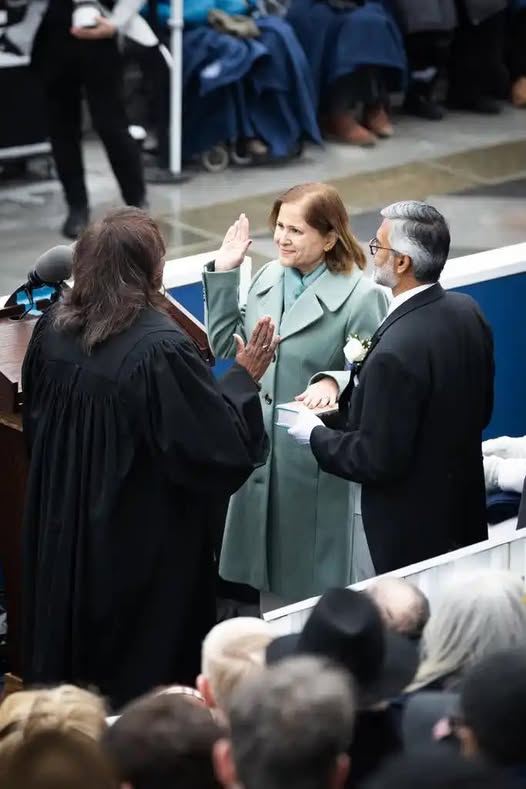

On Saturday, January 17, 2026, former Virginia State Senator Ghazala Hashmi was sworn in as the Lt. Governor of the Commonwealth, a history making moment. She becomes the first Indian American to win a statewide office in that state, and also the first Muslim woman to win statewide office anywhere in the history of the United States.
In fact, some observers call the November elections a “new chapter” in the Commonwealth’s history when a trifecta of Democrats took over the reins after a long hiatus. Hashmi’s election coincided with another history-making event – the election of the first woman governor of the state – Abigail Spanberger, as well as the first Black Attorney General Jay Jones.
Interestingly, while in Virginia, the Lieutenant Governor is elected at the same time as the Governor, the two are elected separately, i.e., they do not run as a ticket. Therefore, it is possible to have a Governor and Lieutenant Governor belonging to different political parties.
Hashmi ran and won on her progressive platform that focused on diversity and inclusiveness, and defeated her Republican opponent John Reid, despite him being an openly gay Republican talk show host.
ADVERTISEMENT

Furthermore, while the Governor is limited by the Constitution of Virginia to serving only one four-year term, there is no limit on the number of terms that can be served by the Lieutenant Governor. Gov. Spanberger replaces former Gov. Glen Youngkin who was term limited.

“Today, I was incredibly honored to take my Oath of Office as the 43rd Lieutenant Governor of Virginia. I look forward to working alongside our Governor and administration to build a Commonwealth focused on affordability, opportunity, dignity, and justice,” Hashmi posted on Facebook after her swearing in where her husband and daughters watched as she placed her left hand on a Quran.
Following her victory in the November 4, 2025 elections Hashmi, in an interview on PBS (PBS.org) on November 5, attributed her victory to policies in Washington. Virginia, which is adjacent to the national capital, is suffering the from the consequences of cuts in the federal work force, the federal shutdown, healthcare access, cuts to the SNAP benefits and rising costs, she said.

Asked how it made her feel to be the first Muslim woman elected statewide and in the country, Hashmi said, “Well, it feels tremendous, most especially because of the reactions and the responses that I’m hearing, not just from Virginians, but all across the country, especially from young women, women who come from diverse backgrounds and other faith traditions.”
She went on to say, “They see an opportunity, they value the representation, and they know how critical it is that diverse voices be at every level of government and also in those spaces where historically our perspectives and our representation has not been.”
“And they understand that value. And I’m very delighted to be the first. But I certainly know that I will not be the last.”
According to Hashmi, the work that is being done in Virginia is “representative of the growing diversity of all of our communities and the need to ensure that multiple perspectives and backgrounds, ethnicities are truly present when decisions are being made.”
Ghazala F. Hashmi is the 43rd Lieutenant Governor of the Commonwealth and her election according to the Lt. Gov website reflects Virginia’s “continued progress toward a more representative and inclusive democracy.”
Prior to taking office as Lieutenant Governor, Hashmi served in the Virginia State Senate representing the 15th District for two terms.
First elected in 2019, “she built a reputation as a thoughtful, effective legislator focused on strengthening public education, expanding access to affordable healthcare, protecting reproductive freedom, and advancing economic opportunity,” Lt. Gov. website says.
She is credited with playing a key role in securing historic investments in K–12 and higher education, supporting working families, and defending civil rights for all Virginians.
Hashmi was born in Hyderabad, India, and raised in the United States. She earned her undergraduate degree from Georgia Southern University, a master’s degree from the University of Virginia, and a Ph.D. in American Studies from Emory University.
She taught for decades at Virginia’s community colleges, and before her election to the State Senate, Hashmi was in community leadership positions, serving on local boards and commissions and working closely with parents, educators, and civic leaders to strengthen public education and expand opportunity.
Her professional career has been defined by a commitment to ensuring that the government reflects and responds to the people it serves, the website notes.
“Lieutenant Governor Hashmi is focused on working with Governor Spanberger and the General Assembly to build a forward-looking Commonwealth: one that invests in education, protects fundamental freedoms, and ensures that every Virginian has the opportunity to thrive.”
The official responsibilities of Virginia’s Lieutenant Governor are spelt out in Article V of the Constitution of Virginia. Hashmi will serve as President of the Senate and preside over the Senate.
As Lieutenant Governor, she is first in the line of succession to Governor. Should the Governor be unable to serve due to death, disqualification or resignation, the Lieutenant Governor shall become Governor.
In addition to these Constitutional responsibilities, the Code of Virginia provides that the Lieutenant Governor shall serve as a member of several other state boards, commissions and councils, including the Board of Trustees of the Jamestown-Yorktown Foundation and the Center for Rural Virginia; the Board of Directors of the Virginia Economic Development Partnership and the Virginia Tourism Authority; the Virginia Military Advisory Council, the Commonwealth Preparedness Council and the Council on Virginia’s Future.