

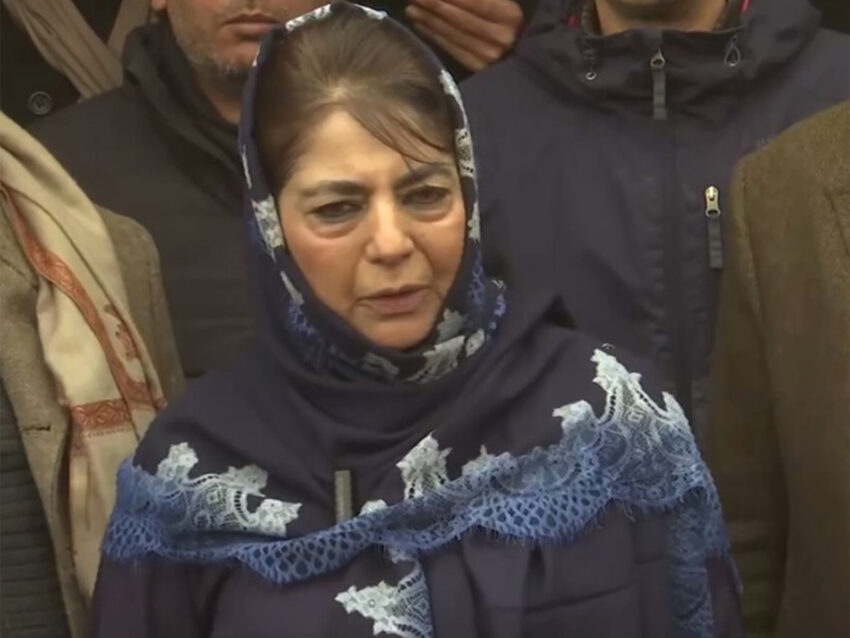
Srinagar (Jammu and Kashmir) [India], January 14 (ANI): PDP chief Mehbooba Mufti on Wednesday criticised Jammu and Kashmir CM Omar Abdullah’s support of the suspension of the Indus Water Treaty, saying that using water as a weapon is against humanity.
Mufti emphasised that the diversion of water flow is against human values, regardless of which country it is used against. She questioned Omar Abdullah’s intentions, asking him to guarantee compensation for the power projects established under the treaty, which were transferred to the National Hydroelectric Power Corporation (NHPC) by his father, Farooq Abdullah, in 1996-97.
“Using water as a weapon is against humanity. Whether it’s Pakistan or any other country, if our water is diverted or will be stopped to flow into another country, I believe this is against humanity. Even if, despite this, Omar Abdullah wants to toe the same line as the BJP, which is to make the people of Pakistan suffer for lack of water… I want to ask Omar Abdullah about the power projects built so far, especially the eight projects Farooq Abdullah handed over to NHPC in 1996-97, which caused us significant losses. Does Omar Abdullah guarantee that the power projects established under the Indus Water Treaty, which Farooq Abdullah transferred to NHPC for a nominal amount, will be compensated?… That’s what I want to know…” she said.
He reiterated his long opposition to the treaty and said its suspension would allow the region to utilise its water resources.
“I have been against it from the very first day. The Indus Water Treaty has greatly harmed us. It is good that the treaty has been suspended,” the Chief Minister said.
He stressed that the move should now be followed by steps to ensure Jammu and Kashmir can effectively use the region’s water resources for its people.
“Now I want measures to be taken so that we are able to use that water for ourselves. We have given two projects to the centre, which we think will benefit us. One is the Jhelum navigation barrage, known as the Tulbul Navigation Barrage,” he said.
He highlighted the benefits of this project, saying, “Water level in Wular will increase, and as a result, water in the Jhelum will also increase. Electricity production will increase, and Jhelum will be used for navigation.”
Following the Pahalgam terrorist attack in April, which killed 26 people, India has, in exercise of its rights as a sovereign nation under international law, placed the Indus Waters Treaty (IWT) in abeyance until Pakistan credibly and irrevocably abjures its support for cross-border terrorism.
The Indus Waters Treaty was signed between India and Pakistan in September 1960, brokered by the World Bank. It allocated control over the waters of the three eastern rivers, Ravi, Beas, and Sutlej, to India, and the three western rivers, Indus, Jhelum, and Chenab, to Pakistan. (ANI)