

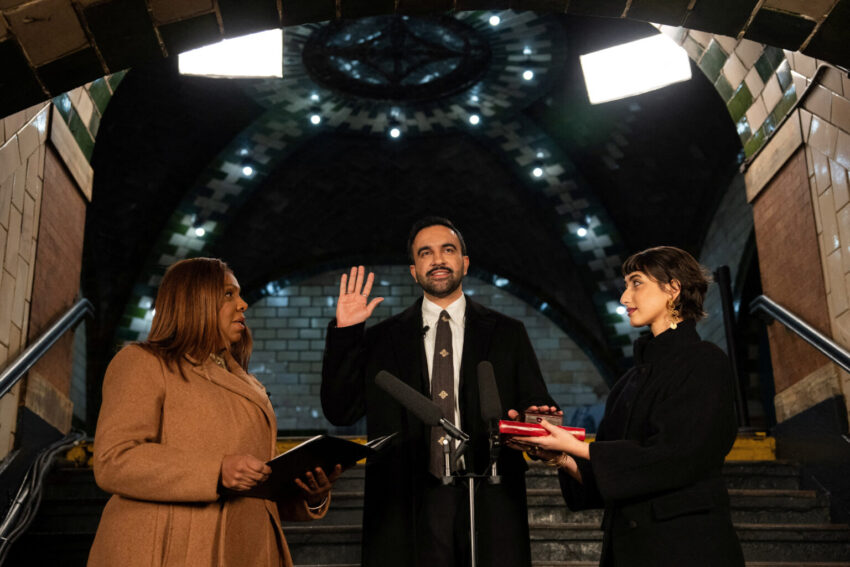

New York City – On a cold January 1, 2026 morning in Lower Manhattan, with tens of thousands gathered and millions more watching from homes, workplaces, hospitals, and subway platforms across the five boroughs, Zohran Mamdani placed his hand on the Holy Quran and took the oath of office, formally beginning his tenure as Mayor of New York City.
It was a moment heavy with symbolism and emotion – not just the swearing-in of a new mayor, but the launch of an administration that Mamdani vowed would “govern expansively and audaciously” and return City Hall to the people who make the city run.
Calling the oath “sacred,” Mamdani said he was humbled by the faith New Yorkers placed in him and clear-eyed about the responsibility ahead. “If you are a New Yorker, I am your mayor,” he declared, addressing both supporters and skeptics alike. “Regardless of whether we agree, I will protect you, celebrate with you, mourn alongside you, and never hide from you.”

A New Era: and a Clean Slate at City Hall
Within hours of taking office, Mayor Mamdani moved swiftly to put his philosophy of government into action. On his first day, he signed the first executive orders of his administration, setting both the tone and the structure for how City Hall will operate.
ADVERTISEMENT
The first executive order revoked all executive orders issued on or after September 26, 2024, effectively wiping the slate clean. The move was designed to give the new administration a fresh start, while selectively reissuing only those prior orders deemed essential to maintaining service, operational continuity, and value-driven leadership.
“Today marks the first step in building an administration that works for all New Yorkers,” Mamdani said. “We’ve established the foundations. Now it’s time to deliver.”
The second executive order laid out the governing framework of the Mamdani administration, formally establishing five Deputy Mayor positions:
First Deputy Mayor
Deputy Mayor for Housing and Planning
Deputy Mayor for Economic Justice
Deputy Mayor for Operations
Deputy Mayor for Health and Human Services
Mayor Mamdani appointed Dean Fuleihan, Leila Bozorg, Julia Su, Julia Kerson, and Helen Arteaga to those roles respectively. The order also formalized the positions of Chief of Staff and Chief Counsel and affirmed the continued operation of key offices under the Mayor’s Office.
Together, the executive orders signaled a break from incrementalism — and a commitment to a government that, in Mamdani’s words, replaces a culture of “no” with one of “how.”

Housing Crisis Front and Center on Day One
Housing emerged immediately as a defining priority of the new administration. With rent due on January 1 for millions of New Yorkers, Mayor Mamdani signed three additional executive orders aimed directly at confronting the city’s housing crisis.
The mayor revitalized the Mayor’s Office to Protect Tenants, transforming it into a central coordinating body charged with defending renters, confronting negligent landlords, and ensuring swift enforcement across city agencies. He appointed Cea Weaver, a nationally recognized tenant organizer and housing advocate, as the office’s director.
Weaver, the longtime Executive Director of Housing Justice for All and the New York State Tenant Bloc, has been instrumental in some of the strongest tenant protections in state history — including the 2019 Housing Stability and Tenant Protection Act, eviction moratoria during the pandemic, Good Cause Eviction protections, and the Housing Access Voucher Program.
On her very first day, Weaver joined Mamdani at a Pinnacle Realty–owned building, where the mayor announced unprecedented intervention in the landlord’s bankruptcy proceedings. Pinnacle is responsible for more than 5,000 housing violations and 14,000 complaints across 83 buildings.
Touring apartments with broken walls, torn floors, and no heat, Mamdani made clear that this administration would no longer tolerate neglect. He directed his Corporation Counsel nominee, Steve Banks, to take precedent-setting action in Bankruptcy Court to protect tenants, improve living conditions, and prevent displacement.
“You cannot hold landlords accountable unless you have a proven, principled fighter at the helm,” Mamdani said. “That’s why protecting tenants begins today.”
Speeding Up Housing, Cutting Red Tape
Two additional executive orders established new task forces aimed at increasing housing supply and cutting bureaucracy:
The LIFT Task Force (Land Inventory Fast Track) will identify city-owned land suitable for housing development, with a deadline of July 1, 2026.
The SPEED Task Force (Streamlining Procedures to Expedite Equitable Development) will work to eliminate permitting and regulatory barriers that slow construction and raise costs.
Both efforts will be overseen by Deputy Mayor Leila Bozorg, with SPEED co-led by Deputy Mayor Julia Kerson.
The goal, Mamdani said, is simple: build more homes, faster — and make it easier for New Yorkers to actually live in them.

A Vision Rooted in Working People
In a sweeping inaugural address, Mamdani laid out a governing philosophy that rejects small expectations and embraces bold public action. He spoke of crowded classrooms, broken elevators in public housing, buses that never arrive, and wages that fail to keep up — realities he said working New Yorkers know all too well.
“For too long,” he said, “City Hall has belonged to the wealthy and well-connected.” His administration, he promised, would change that — delivering an agenda of safety, affordability, and abundance, while refusing to “cower before challenges others deem too complicated.”
Mamdani openly embraced his identity as a democratic socialist, vowing not to govern with shame or apology. He pledged universal childcare funded by taxing the wealthiest New Yorkers, a rent freeze for stabilized apartments, free and fast buses, property tax reform, and a new Department of Community Safety focused on mental health.
“These policies aren’t just about the costs we make free,” he said. “They’re about the lives we fill with freedom.”

“New York Belongs to All Who Live in It”
Throughout the address, Mamdani returned to a single question: Who does New York belong to? His answer – echoing the South African Freedom Charter — was unequivocal: “New York belongs to all who live in it.”
He described a city of “8.5 million cities,” bound together by shared struggle and solidarity – a place where mosques, churches, synagogues, temples, and secular spaces coexist; where immigrants, workers, homeowners, tenants, artists, and small business owners all deserve dignity.
Standing before City Hall, Mamdani urged New Yorkers not just to watch, but to participate. “Victory,” he said, “is something that transforms lives — and something that demands effort from each of us, every single day.”
With his hand once placed on the Quran, his first executive orders signed, and his administration now in motion, Mayor Zohran Mamdani made one thing clear: the work, as he put it, “has only just begun.